Since the dawn of history, the textile industry has been one of the most significant indicators of human progress. It is not merely a means of covering the body, but a reflection of civilization, taste, and culture.
From simple natural fibers to advanced smart fabrics, this industry has traveled a long journey filled with creativity and technological evolution.
The Early Beginnings of the Textile Industry
The textile industry began thousands of years ago, when humans used natural fibers such as linen, cotton, and wool to make clothing and shelter covers.
Spinning and weaving were done manually using simple tools like spindles and wooden looms, and fabrics were considered valuable goods—sometimes even used as currency in ancient civilizations.
In ancient Egyptian civilization, Egyptians became famous for producing pure linen used in making garments for kings and priests.
Meanwhile, in India and China, silk fabrics were symbols of luxury and wealth, exported to the ancient world through what became known as the Silk Road.
The Industrial Revolution and the Beginning of a Great Transformation
In the 18th century, the world witnessed the Industrial Revolution, which completely changed the face of the textile industry.
The invention of spinning and weaving machines led to increased production and reduced effort and time.
Massive factories appeared in England and across Europe, turning textiles into a global commercial commodity.
Some of the key inventions that transformed the industry at that time included:
- The Spinning Jenny: Allowed multiple threads to be spun simultaneously, significantly boosting productivity.
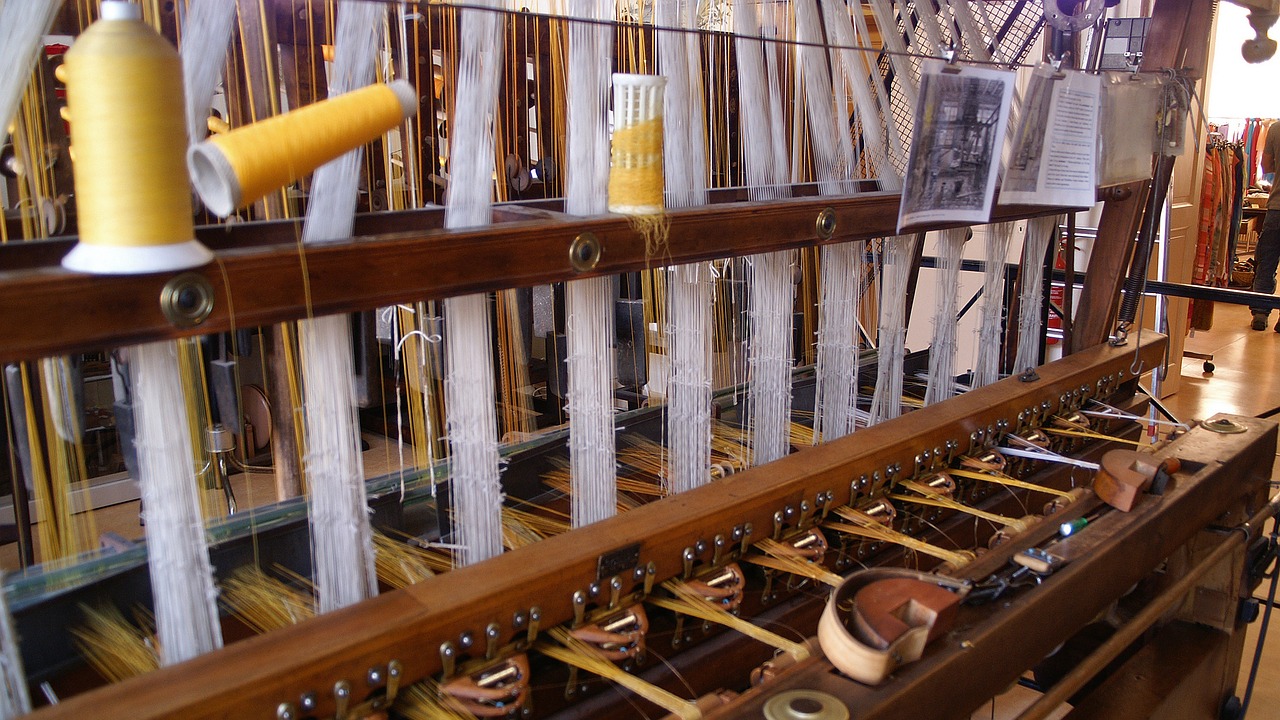
- The Jacquard Loom: Enabled the automatic weaving of patterned or decorated fabrics using punched cards.
- The Steam Engine: Powered factory machinery and raised production efficiency to unprecedented levels.
The Emergence of Synthetic and Industrial Fabrics
In the 20th century, a new revolution emerged with the invention of synthetic fabrics such as nylon and polyester.
These materials met market demands for stronger, cheaper fabrics that resisted wrinkles and moisture.
They expanded textile applications to include sportswear, home furnishings, and even automotive and aircraft upholstery.
Technology also enabled the production of fabrics with special properties, including:
- Water- and stain-resistance.
- High elasticity and good breathability.
- Antibacterial qualities suitable for medical use.
The Impact of Modern Technology on the Textile Industry
In the modern era, technology has become the driving force behind textile evolution.
Thanks to artificial intelligence, 3D printing, and robotics, new techniques have emerged that completely redefine how fabrics are designed and manufactured.
Today, fabrics can be digitally designed and tested for performance before physical production.
Recent innovations include:
- Smart Fabrics: Embedded with tiny sensors that measure temperature or heart rate, used in medical and sportswear.
- Digital Textile Printing: Allows for highly detailed, vibrant designs without the water-intensive traditional dyeing process.
- 3D Textiles: Used to create customized shoes and garments precisely fitted to body shapes.
Sustainability: The New Challenge for the Textile Industry
As global environmental awareness grows, consumers and companies are seeking more sustainable solutions.
The industry is now shifting toward eco-friendly fabrics that minimize water and energy consumption and reduce waste.
Examples of sustainable materials used today include:
- Organic cotton grown without chemical pesticides.
- Recycled fibers made from plastics and old garments.
- Bamboo and natural linen fabrics.
Some companies have also begun implementing circular production systems, where fabric scraps are recycled to create new products.
The Textile Industry in Turkey and Its Global Position
Today, Turkey stands among the leading countries in the textile industry, combining deep-rooted experience with modern technology.
It hosts thousands of factories producing high-quality fabrics exported to Europe, the Middle East, and Africa.
Turkish fabrics are renowned for their:
- High-quality yarns and durable weaves.
- Diverse designs and colors.
- Ability to meet varying market demands in terms of quantity, price, and quality.
The Future of the Textile Industry: AI and Digital Transformation
The future holds vast opportunities for the textile sector.
Technologies like Big Data and Artificial Intelligence (AI) are expected to play a central role in improving production efficiency and analyzing consumer trends.
Factories will become smarter, capable of predicting demand and automatically controlling fabric quality.
Meanwhile, technologies such as the Internet of Things (IoT) will enable real-time monitoring of spinning and weaving processes—ensuring faster, more accurate production with minimal waste.
Conclusion
The evolution of the textile industry worldwide is a human success story filled with innovation and resilience.
From a simple loom in a small village to smart factories powered by AI, this industry has proven its ability to adapt to every era.
With rapid technological progress and growing sustainability awareness, the future promises even more opportunities for companies and investors in this vital sector.
Fabrics are no longer just physical products—they have become a symbol of progress, innovation, and beauty.